This specialist article compares invasive and non-invasive methods for measuring the gas fill rate of double and triple glazed insulating glass units (IGUs). It was originally written by Mauri Saksala, who has worked in the glass industry for over 25 years in positions at Sparklike, Glaston (formerly Tamglass) and Rakennuskone Oy.
The key question is simple: why break the unit for gas analysis when non-destructive methods are available?
“Keeping pace with high performing insulating glass products is a struggle for quality control, especially when it comes to insulating gas retention. Glazing products today have higher and higher performance needs, and the requirements for better products are growing steadily.” Mauri Saksala
Energy Performance and Gas Retention in Insulating Glass Units
Modern glass products include a range of elements that improve their properties, and one of the most important is energy efficiency in both heated and cooled buildings. Insulating glass units improve energy performance through:
- Low-E coatings
- multiple glass panes
- a medium between the panes: air, vacuum or an insulating gas, typically argon or krypton
Insulating gas is filled into the cavity either in a gas press on the IG line or manually into finished units. Read more about gas filling equipment and how gas filling works.
Manufacturers face two challenges: confirming that the unit has the correct gas fill rate, and making sure the gas stays inside the sealed unit over time. Gas leakage is usually caused by imperfect sealing and cannot be seen. Since insulating glass and window suppliers can carry product liability for several years after delivery, verifying the gas fill rate before shipping is essential.

Why Argon Gas Retention Matters
Insulating gases consist of small molecules and are naturally prone to leaking over time. For this reason, manufacturers aim for a high initial gas fill rate directly after filling, typically 95 % or more.
Requirements vary by region, but the industry has established best practices. In Europe, the EN 1279 standard sets requirements for the gas leakage rate of insulating glass units: the maximum allowed leakage is 1 % per year.
Even within this limit, the gas fill rate drops noticeably over the lifetime of a unit. The table shows how the gas fill rate develops over 10 years at the maximum leakage rate:
| Initial gas fill rate | After 10 years |
|---|---|
| 95 % | 85.9 % |
| 90 % | 81.4 % |
| 85 % | 76.9 % |
This is why gas retention is a long-term performance issue, not only a production parameter. A unit that is filled correctly but leaks at the maximum allowed rate loses around a tenth of its insulating gas within ten years, and the initial gas fill rate determines how much margin remains.
Read our blog: Key Takeaways from EN 1279-3 2018
Invasive vs. Non-Invasive Gas Analysis Methods
Invasive Gas Measurement
Invasive methods take a gas sample from inside the unit by penetrating the IGU seal. The sample is then analyzed, for example with a handheld analyzer or by gas chromatography, which is the test method described in ASTM E2269.
Invasive methods are generally affordable, robust and accurate. However, every test damages the unit:
- the unit cannot be delivered to the customer
- the same unit cannot be measured again
The actual cost of each test therefore includes the destroyed unit. In practice, this limits invasive methods to random sampling and laboratory use.
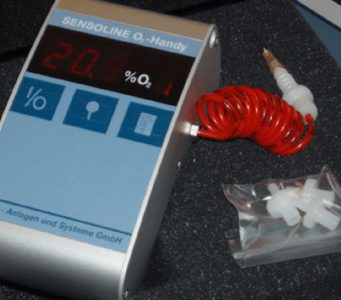
Sensoline argon gas testing device
Non-Invasive Gas Measurement
Non-invasive methods measure the gas fill rate without breaking the unit, so the IGU stays intact and can be delivered or tested again.
One widely used non-invasive method is spark-based measurement, also known as Plasma Emission Spectroscopy (PES). A controlled spark is ignited through the glass, and the argon or krypton concentration is calculated automatically from the colour and emission spectrum of the ionized gas. With Sparklike Handheld Nova™, a measurement takes about 2 seconds.
Spark-based measurement is fast, accurate and well suited for routine quality control. It is commonly used for double glazed units, where the measurement is made from the monolithic glass side through a non-coated surface. Because the unit remains intact, measurements can be repeated as often as the quality system or the end customer requires.
The limitation of spark-based technology is that it is suited for double glazed units with no more than one Low-E coating.
Read our article ASTM E2649-20 Explained: Determining Argon Concentration in Insulating Glass Units (IGUs)

Measuring Complex IGU Structures
Spark-based measurement covers most double glazed units, but many of today’s high-performance glazing products are more complex. Laser-based gas analysis extends non-invasive measurement to these structures, so their quality assurance can match the performance expected of them.
With laser-based technology, it is possible to measure:
- triple glazed units, including the gas fill rate of each cavity. Read more in Are Triple Glazed IGUs Necessary to Obtain Energy Efficient Windows?
- units with multiple Low-E coatings
- laminated and other advanced glazing structures
How laser-based measurement works
Sparklike Laser™ devices use TDLAS (Tunable Diode Laser Absorption Spectroscopy). A modulated laser beam at 760 nm is directed into the unit, and the device determines the oxygen content in the cavity from the intensity and harmonic changes in the reflected signal. Since any oxygen in the cavity comes from remaining air, the oxygen content can be converted into the insulating gas concentration, most commonly argon or krypton.
For triple glazed units, the device first measures both cavities together and then the first cavity, and calculates the gas fill rate of the second cavity from these results. A measurement with Sparklike Laser Portable™ takes 20 to 30 seconds, and the accuracy of Laser Portable 2.2 has been validated by ift Rosenheim.
Read more: How TDLAS Measures Gas Fill Rate in Sealed Units
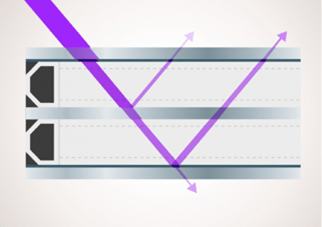
How Sparklike Laser™ devices measure insulating glass units without having to break the glass
Gas Fill Measurement in Production Quality Control
Non-invasive gas measurement has a central role in modern IGU quality control. Both spark-based and laser-based technologies are used, depending on the glass structure and production requirements. Measurement can be set up in two ways:
- Mobile measurement: devices carried to the unit for spot checks, batch testing and routine verification, both in the factory and on-site.
- In-line measurement: systems installed on the IG production line and connected to the production control software or line control system.
With in-line measurement, manufacturers have gas fill rate data from every unit produced, not only from random samples. This supports:
- reliable and repeatable quality assurance
- early detection of sealing or filling issues, before more units are affected
- documented, traceable results for each sealed unit
Because the measurement doesn’t damage the unit, the same unit can also be measured again later, for example to follow its gas retention over time.
In today’s IGU manufacturing, quality control is not only about eliminating rejects. Verified gas fill rates have become a sales argument, supporting product reliability, compliance and customer confidence.
Sparklike Devices for Non-Invasive Gas Analysis of IGUs
Sparklike offers non-invasive gas measurement solutions for different insulating glass structures and quality control needs:
Sparklike Handheld Nova™
Spark-based non-invasive device for measuring argon and krypton gas concentration in double glazed insulating glass units.
Sparklike Laser Portable™
Laser-based non-invasive device for measuring gas concentration in double and triple glazed insulating glass units, including structures with coatings and lamination.
Sparklike Laser Components™
Sparklike’s TDLAS measurement technology supplied as components, for manufacturers and machine builders who build the mechanical movement and line integration themselves.
Sparklike Laser Integrated™
Automated laser-based insulating gas measurement system designed for integration into the IG production line. Suitable for double and triple glazed insulating glass units with coatings and lamination.