Buildings account for around 40 % of primary energy consumption in Europe and North America, and windows are one of the main sources of heat loss. Research shows that argon-filled double glazed units can reduce a building’s energy consumption by around 25 %, and argon-filled triple glazing by up to 50 % in office buildings, compared with air-filled windows. This article looks at how buildings consume energy, why repair construction is needed, and how structural energy efficiency can be achieved through insulation and high-quality insulating glass units. These savings depend on the units performing as specified, which is why a correct gas fill rate in every sealed unit matters.
BUILDING ENERGY CONSUMPTION
Where Buildings Use Energy
In North America and Europe, buildings account for around 40 % of primary energy consumption (Cao, Dai & Liu, 2016). This figure can be reduced significantly when buildings are designed, constructed and used with energy efficiency in mind.
According to the International Energy Agency (IEA), lighting accounts for 20 % of the total energy use in office buildings, heating for 16 % and cooling for 14 % (Ürge-Vorsatz, 2012). This is why repair construction and structural energy efficiency are key to improving existing buildings.
Read our article Sustainable Glass Facades Depend on Gas Fill Quality: Long-Term Thermal Performance of Insulating Glass Units
The Role of Windows in Energy Savings
Windows typically make up 15 to 20 % of a building’s wall surface. It has been estimated that a building’s energy consumption could be reduced by 25 % if the windows were argon-filled double glazed units. In office buildings, where glass surfaces are generally much larger, argon-filled triple glazed units can achieve energy savings of up to 50 % compared with air-filled windows (Lange, 2012).
Windows are therefore not only an aesthetic element. They have a key role in a building’s maintenance costs.
Read The Role of Insulating Gases in Energy Efficient Windows.
Comparing Glazing Options: U-value and Oil Consumption
To illustrate the effect on maintenance costs, AkzoNobel, a global supplier of products for the construction industry, converted the U-values of different glazing types into oil consumption. Table 1 shows the results for single, double and triple glazed units.
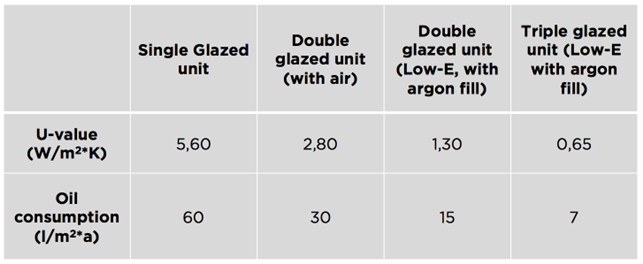
The table shows that argon-filled insulating glass units reduce oil consumption considerably. The largest difference is between single glazing and argon-filled, Low-E coated triple glazing: triple glazing reduces oil consumption by around 88 %, from 60 to 7 litres per square metre per year.
More about the Akzo Nobel study on our blog post Argon-Filled Units: Why Fill Rate Matters for Reliable Insulation Performance.
U-value Requirements in Finland
Requirements for repair and renovation work often set minimum levels for energy efficiency. These requirements are country-specific, and the following values are from Finland.
The building component-specific U-value reference for windows and doors in new buildings is 1.0 W/m²K (Ojanen et al., 2017, 8). In most cases, it is worth aiming for solutions that go beyond the minimum requirement. A good goal for repair construction is 0.7 W/m²K (Lylykangas et al., 2016, 2).
Read What is U-value of Windows?
Why Installation Quality Matters
These figures explain the growing interest in energy efficiency. However, the discussion often focuses on energy production and transmission. If insulation in buildings is not installed properly, the cost savings and climate benefits achieved earlier in the chain can be lost.
The next chapter looks at the leading causes for repair construction and how structural energy efficiency can be achieved.
LEADING CAUSES FOR REPAIR CONSTRUCTION AND ENSURING THE STRUCTURAL ENERGY EFFICIENCY
Why Buildings Need Repair Construction
Buildings are being repaired more often than before because, for one reason or another, they no longer meet the expectations of their inhabitants or owners. The causes can be divided into three categories (Stolt, 2015):
- a change in the building’s function
- wear and aging of buildings and their components
- damage to buildings and their components
More related reading: Window Replacement and Insulating Gas in Glass for Europe’s Agenda
Change in the Building’s Function
A change in how a building is used can create a need for repair construction. This is often closely linked to the needs that inhabitants or owners have recognized and experienced. As a result, changes in a building’s function are strongly influenced by time and trends (Stolt, 2015).
Wear and Aging of Buildings
Wear and aging refer to processes that significantly reduce the usability of a building or its components. Wear results from normal use. Aging is caused by the combined effect of internal chemical processes and external stress factors.
The reduced usability can be assessed from several perspectives, such as building safety, economic efficiency and living comfort. The property owner is responsible for eliminating any factors that may cause safety or health risks, and must ensure that the premises meet the minimum requirements (Stolt, 2015).
Improving Indoor Comfort and Energy Efficiency
Repair construction is often started to improve a building’s indoor air quality and energy efficiency. Improving the thermal insulation of structures is a simple way to increase both energy efficiency and living comfort. Thermal comfort indoors also improves when drafts caused by cold surfaces and uncontrolled air leakage are reduced (Ojanen et al., 2017, 8).
In residential buildings, living comfort depends not only on indoor air temperature but also on the surface temperature of the surrounding structures and the relative humidity of the air (Lylykangas et al., 2016, 2).
Structural Energy Efficiency Through Passive Solutions
Structural energy efficiency can significantly improve both living comfort and energy efficiency. It is achieved through passive energy saving systems, methods and technologies, such as adequate thermal insulation of structures and the use of high-quality insulating glass units.
Read also Degradation of Insulating Glass Units – How Sparklike Helps Thermal Performance Monitoring.
Sun shading and window coatings also support passive energy saving by reducing the need for indoor cooling. These solutions require no additional maintenance after installation, while they significantly improve indoor air quality and reduce heat loss. When repair construction aims to improve the energy efficiency of the whole building, the work is mainly based on proper heating and cooling and on well-insulated, airtight structures (Ojanen et al., 2017, 8).
The Role of Insulation and Insulating Glass Units
As noted at the beginning of this article, argon-filled double glazed units could reduce a building’s energy consumption by 25 %. In office buildings, argon-filled triple glazed units can achieve energy savings of up to 50 % compared with air-filled windows (Lange, 2012).
In repair construction, proper thermal insulation of structures is a cost-effective way to reduce the need for heating. Together, well-insulated structures and high-quality insulating glass units can significantly reduce energy consumption and ensure thermal comfort (Lylykangas et al., 2016, 2).
Read about The Re-use Potential of Insulating Glass Units
These savings depend on insulating glass units performing as specified, which requires a correct gas fill rate in every sealed unit.
REFERENCES:
Cao, Xiaodong, Dai, Xilei, Liu, Junjie: Building energy-consumption status worldwide and the state-of-the-art technologies for zero-energy buildings during the past decade, Energy and Buildings, 2016, s. 1
Lange, Dieter: Energy saving without noble gas filling?, Akzo Nobel, 2012, s. 1
Lylykangas, Kimmo, Andersson, Albert, Kiuru, Jari, Nieminen, Jyri & Päätalo, Juha: Rakenteellinen energiatehokkuus, opas. RTT eristeteollisuus ja ympäristöministeri 2016, ss. 2–3
Ojanen, Tuomo, Nykänen, Esa, Hemmilä, Kari: Rakenteellinen energiatehokkuus korjausrakentamisessa, opas. ymp.rist.ministeri., Rakennustuoteteollisuus RTT ry ja Puutuoteteollisuus ry, 2017, s. 8
Stolt, Toni: Korjausrakentamisen tietomallintaminen ja Tekla Structures -komponentit, Metropolia ammattikorkeakoulu, 2015, s. 8-9
Ürge-Vorsatz, Diana: Global Energy Assessment, Chapter 10 – Energy End-Use: Buildings, 2012, s. 660