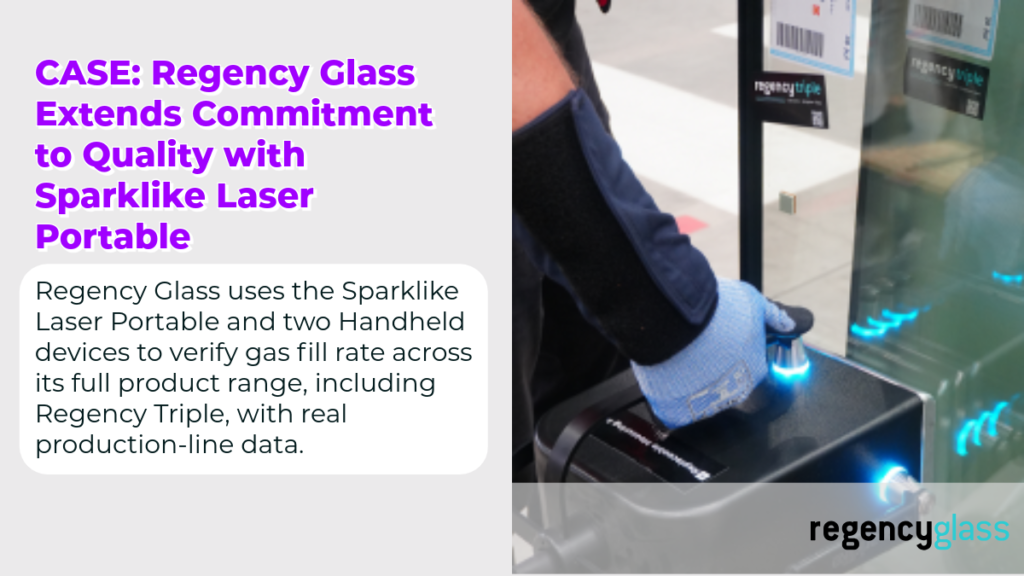
Summary – How to Monitor Gas Filling Equipment for Insulating Glass Units
Quality assurance:
- Gas filling equipment can face issues like leaks, inaccurate fill levels, or contamination, all of which reduce IGU performance.
- Poor gas accuracy risks long-term product failures, warranty claims, and customer dissatisfaction.
- Sparklike devices allow non-invasive, real-time measurement of gas concentration in fully assembled IGUs, improving reliability and consistency.
Cost efficiency:
- Detecting and correcting gas fill issues immediately reduces scrap, rework, and downtime.
- Integration into production lines enables continuous monitoring without halting operations.
- Lower reject rates and fewer warranty claims protect profitability.
Standards and compliance:
- Regulatory requirements (e.g., 90% argon in double glazing) demand precise, verifiable measurements.
- Sparklike technology ensures IGUs meet international performance standards before delivery.
- Automated options like Sparklike Laser Integrated™ provide traceable data for audits and certifications.
Adaptability across production:
- Handheld™ – practical solution for spot checks on double glazing.
- Laser Portable™ – flexible testing of double/triple glazing with coatings.
- Laser Integrated™ – in-line solution for automated factories.
In insulating glass unit (IGU) production, the gas filling process has a direct effect on product performance. Filling the space between the glass panes with an inert gas such as argon, krypton or xenon is an established way to improve thermal insulation. However, even advanced gas filling machines can produce inconsistent gas fill rates, leaks or contamination.
For manufacturers, these issues go beyond immediate production defects. Poor gas filling accuracy can lead to long-term performance degradation, customer complaints and costly warranty claims. As energy efficiency requirements continue to tighten, verifying the gas fill rate of every sealed unit is becoming essential.
Sparklike’s non-invasive gas measurement devices verify the gas fill rate inside fully assembled IGUs without opening the units or stopping production. Real-time results allow manufacturers to detect and correct filling issues immediately, reducing downtime and rework.
Read the case: How an Argon Tester Revealed Quality Issues in Sealed Units
The Role of Gas Filling Equipment in IGU Production
Gas filling equipment replaces the air between the glass panes with an inert gas, such as argon or krypton, at a specified concentration. Gas filling machines range from manual and semi-automatic systems for smaller production to fully automated solutions in large facilities, and they are built to handle different gas types, filling pressures and production rates.
How gas filling works
There are two common approaches. In filling through the spacer, gas is injected through a hole in the spacer frame with a filling lance while the air escapes through a second hole. Because argon is heavier than air, the gas is typically introduced from the bottom so that it pushes the air out at the top. The holes are then sealed. In gas press filling, the unit is filled with gas inside the press during assembly, before the panes are pressed together and sealed. This method is common on automated IG lines.
What affects the gas fill rate
Several factors determine how much gas ends up in the sealed unit:
- Flow rate: a flow that is too high creates turbulence, which mixes gas and air instead of pushing the air out.
- Fill time: larger units and wider cavities need more time to reach the target concentration.
- Unit geometry: triple glazed units have two cavities to fill, and shapes other than rectangles can make it harder to displace all the air.
- Sealing: fill holes and the edge seal must be closed properly, or gas escapes after filling.
- Machine settings and calibration: settings must be adjusted for each unit type and checked regularly.
Read the case: How Lipoplast uses Sparklike Laser Portable to detect calibration drift and seal issues
Common challenges
Even when the equipment works within optimal parameters, challenges remain:
- Leakage during or after filling: sealant issues or equipment malfunctions can cause gas to escape. Read Would I be able to use a Sparklike device to determine whether the IGU seal has failed?
- Inaccurate fill levels: calibration problems or incorrect settings can leave the gas fill rate below the required level, reducing the insulating value of the unit.
- Contamination: air or moisture can enter the unit during filling, lowering the quality of the gas fill.
If these issues go undetected, they affect not only the immediate quality of the unit but also its long-term performance. Measuring the gas fill rate directly after filling shows whether the machine settings are correct and makes it possible to adjust them before more units are produced.
Related reading: Improve Gas Press and Filling Accuracy with Sparklike Laser Integrated™
Ensuring Compliance with Industry Standards
Beyond operational challenges, IGU manufacturers must meet increasingly strict requirements in construction and energy efficiency. Standards and building codes set requirements for the gas concentration in insulating glass units, as well as for how it is tested and how much gas may escape over time. Examples include:
- EN 1279-3: requirements for gas leakage rate and gas concentration tolerances in Europe
- ASTM E2269: test method for determining argon concentration in sealed insulating glass units
- GB/T 11944: the Chinese standard for insulating glass units
In practice, many manufacturers target a gas fill rate of 90 % or higher in argon-filled units to reach their declared U-values with a safety margin. If units do not meet the requirements, manufacturers risk complaints, recalls and, in the worst case, the loss of certifications. Watch how Pilkington Polska carries out argon quality control.
Read more: Views on gas fill: Why is argon used in windows
Sparklike devices help manufacturers verify the gas fill rate of each sealed unit before it leaves the factory, either in-line or after production. Stored measurement results also provide traceable data for audits, certifications and customer documentation.
How Sparklike Measures Gas Fill Rate Without Opening the Unit
Traditional gas concentration measurement in IGUs has been invasive and time-consuming. Sample units had to be destroyed, or production stopped for testing. Sparklike devices measure the gas fill rate through the glass of fully assembled IGUs, so units stay intact and production can continue.
Sparklike uses two measurement technologies:
- Plasma Emission Spectroscopy (PES): used in Sparklike Handheld Nova™, which measures standard double glazed units in about 2 seconds.
- Tunable Diode Laser Absorption Spectroscopy (TDLAS): used in Sparklike Laser Portable™, Laser Components™ and Laser Integrated™, which also measure triple glazed, coated and laminated units. A measurement with Laser Portable takes 20 to 30 seconds.
The accuracy of Sparklike Laser Portable 2.2 has been validated by ift Rosenheim, and later versions are based on the same TDLAS technology. Read more on our blog Comparison Of Gas Concentration Measurement Methods in IGUs: Gas Chromatography And TDLAS.
Because the measurement is non-destructive, manufacturers can measure directly after filling and see whether flow rate, fill time and machine settings produce the target gas fill rate. This gives two key advantages:
Continuous quality control: units can be measured without stopping the production line, either in-line with Laser Integrated or as frequent checks with portable devices.
Immediate feedback: operators can adjust equipment settings as soon as a deviation appears, before more units are produced with the same error.
Choosing the Right Setup: In-Line or Portable Measurement
Sparklike devices fit both fully automated IG lines and more manual production. The right setup depends on production volume, the glazing types produced and how often units need to be measured.
In-line measurement for automated production
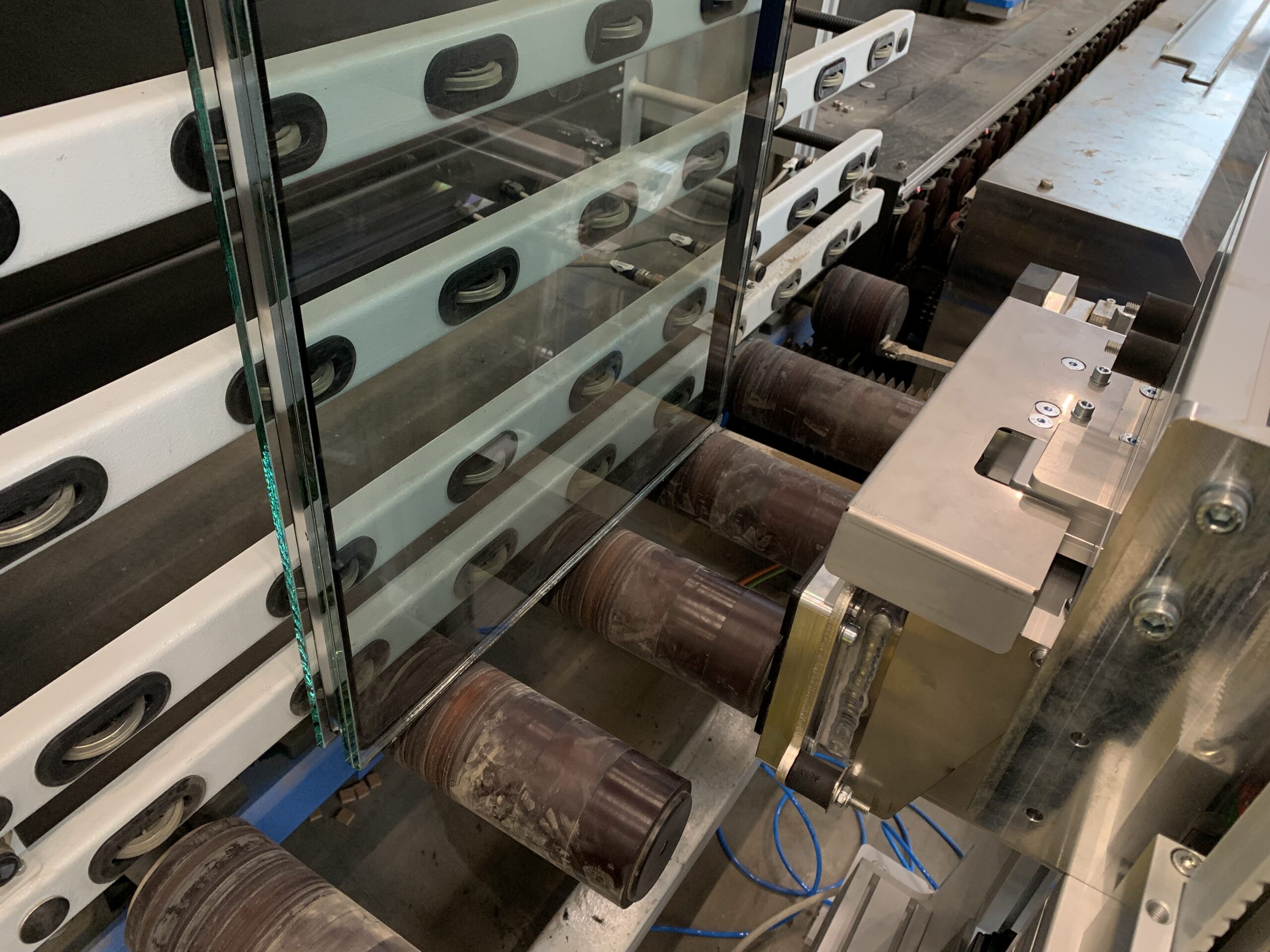
Sparklike Laser Integrated™ is a measurement station installed on the IG production line after gas filling. It measures the gas fill rate of units as they pass, without stopping the line. Deviations from the target gas fill rate are detected immediately, so the gas filling process can be adjusted before more units are affected. Laser Integrated measures double and triple glazed units, including coated and laminated glass.
Read how EDL Glass invested in Sparklike Laser Integrated to strengthen quality assurance.
The video below shows Laser Integrated measuring gas concentration on an IG production line.
Portable measurement for flexible quality control
In smaller-scale or more manual production, portable devices make it possible to test specific batches or individual units as needed. Sparklike Handheld Nova™ is suited for fast spot checks on double glazed units. Sparklike Laser Portable™ also measures triple glazed, coated and laminated units, and can be used both in the factory and on-site.
Conclusion: Protecting Quality and Profitability
Quality control equipment is not only about meeting standards or improving production efficiency. It also protects the long-term profitability of the business. An underfilled or leaking unit that reaches the market can lead to warranty claims, replacement costs and damage to the manufacturer’s reputation, all of which cost far more than detecting the issue on the production line.
Measuring the gas fill rate of sealed units without destroying them gives manufacturers three concrete benefits:
- Lower operational costs: less rework and waste, and gas filling settings can be optimized based on measured results.
- Fewer warranty claims: underfilled or leaking units are identified before they leave the factory.
- Consistent product quality: customers receive units with the specified gas fill rate, which supports long-term customer relationships.
Whether the challenge is gas fill accuracy, leakage or contamination, Sparklike offers in-line and portable solutions for verifying gas fill rate at every stage of IGU production.
Contact Sparklike for more information and support on measuring argon concentration in IGUs.