Summary: Energy Efficient Windows: The Role of Insulating Gases in Energy Efficiency
- Types of gases: Argon is cost-effective and widely used; krypton offers superior insulation for thinner gaps; xenon provides maximum performance but at high cost.
- Thermal performance: Insulating gases reduce heat transfer through conduction and convection, lowering energy use for heating and cooling.
- U-value improvement: Filling IGUs with inert gases significantly lowers U-values, with krypton and xenon offering the best results for high-performance windows.
- Condensation control: Gas-filled units maintain warmer interior glass surfaces, preventing condensation, mold, and frame damage.
Energy efficiency in buildings is becoming increasingly important as the industry works to reduce carbon footprint and energy consumption. Insulating Glass Units (IGUs) play a central role in this effort, and the choice of insulating gas within these units has a direct impact on their thermal performance. This article looks at the types of insulating gases used in IGUs, how they affect thermal performance, and what it takes to maintain that performance over time.
Read also: Energy Savings in Buildings
Types of Insulating Gases
Argon
Argon is the most widely used gas in IGUs. It is roughly six times denser than air, and this added density slows the heat transfer that occurs through the glass. Combined with its low cost and abundance, this makes argon the industry-standard choice for energy-efficient windows.
Krypton
Krypton insulates even better than argon, at roughly twelve times the density of air. It performs best in narrow cavities, which makes it well suited to triple glazing and slim-profile units where there isn’t room for a wider argon-filled gap. It costs more than argon, but for high-performance windows, the efficiency gain justifies the price.
Xenon
Xenon reduces heat transfer more effectively than either argon or krypton, but it is also by far the most expensive of the three. Its use is largely limited to niche, maximum-performance applications where cost is not the primary constraint.
The table below summarizes how the three gases compare on thermal conductivity — the property that most directly drives their insulating performance:
| Gas | Thermal Conductivity (W/m·K) | vs. Air | Typical Use |
|---|---|---|---|
| Air | ~0.024 | baseline | Standard, non-insulated units |
| Argon | ~0.016 | ~35% lower | Standard energy-efficient IGUs, wider cavities |
| Krypton | ~0.009 | ~65% lower | Narrow cavities, triple glazing, high-performance units |
| Xenon | ~0.005 | ~80% lower | Niche, maximum-performance applications |
Gas selection for building applications has been studied extensively, and reviews of gas-filled panel technology confirm that the choice of fill gas is one of the most effective levers available for improving a glazing unit’s thermal performance (Baetens et al., 2009).
Thermal Performance of Insulating Glass Units
Heat Transfer Reduction
Insulating gases reduce heat transfer inside the IGU in two ways: through conduction and through convection. Argon, krypton, and xenon all conduct heat less readily than air, so replacing air with any of them reduces heat loss. The result is better insulation and lower energy use for heating and cooling.
U-Value Improvement
The U-value measures how much heat passes through a window. It expresses heat loss per square meter for each degree Celsius of temperature difference between inside and outside, calculated using internal and external surface conductance coefficients in accordance with BS EN 673. Lower U-values mean better insulation. Insulating gases lower a window’s U-value by reducing the thermal conductivity of the gas layer — krypton and xenon offer the biggest improvements, thanks to their lower conductivity. Energy-efficient windows should always state their U-value, for example through a National Fenestration Rating Council (NFRC) label.
Gas Concentration and Compliance
Choosing a low-conductivity gas only delivers its rated U-value if it stays at the concentration the manufacturer declared. This is where standards come in. EN 1279-3 sets a maximum average gas leakage rate of 1% per year, and requires that measured gas concentration not fall more than 5 percentage points below the nominal value stated by the manufacturer. For a unit with a declared 90% argon fill, that means it’s expected to stay above roughly 85% argon for its declared service life.
The leak pathway itself is well documented: gas loss occurs primarily through the edge seal and spacer system, which is why the design and durability of these components have been the subject of dedicated research (Bergh et al., 2013). More recent work has also shown how directly this connects to real-world performance — as gas concentration falls, thermal performance degrades measurably, and reliable non-destructive measurement is essential for tracking that degradation over an IGU’s service life (Likins-White et al., 2023). We cover this standard, and what it means for manufacturers in practice, in more detail in Why Gas Concentration Matters: Key Takeaways from EN 1279-3:2018 and Ensuring Compliance: Standards and Regulations in Insulating Gas Measurement.
Condensation Prevention
Poorly insulated windows are prone to condensation. Insulating gases help by keeping the interior glass surface warmer. A warmer surface is less likely to reach the dew point, so condensation is less likely to form. This protects glass clarity and helps prevent mold growth and frame deterioration.

Verifying Gas Fill in Practice
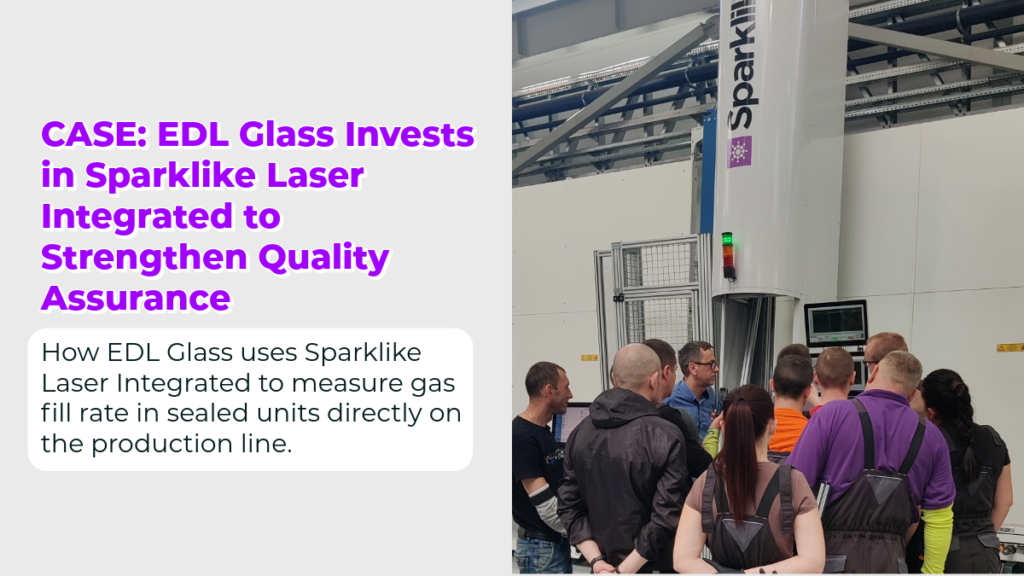
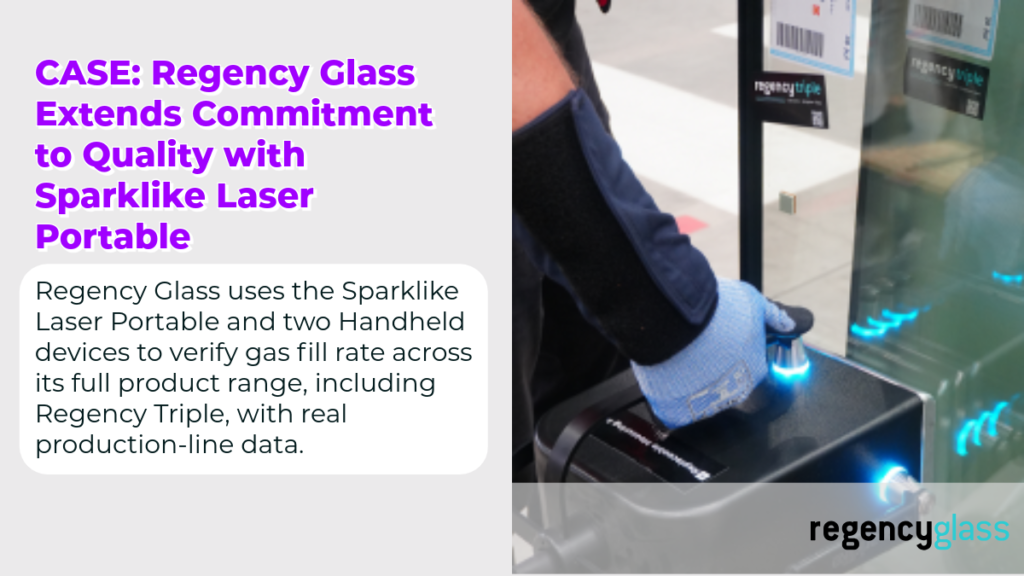
Choosing the right gas is only half the equation — confirming it’s actually present at the declared concentration is the other half. Because gas fill can’t be assessed visually, manufacturers and installers rely on non-destructive measurement to verify fill rates during production and to check for gas loss later in the unit’s service life. This is the practical, ongoing complement to gas selection: it’s how the U-value improvements described above are actually confirmed and maintained in the field, rather than assumed. Sparklike’s Handheld Nova™ and Laser Portable™ devices are designed primarily for non-destructive gas measurement in production, but they have also proven effective for on-site field use — as shown in this case study on argon testing of newly installed windows and British Fenestration Rating Council’s (BFRC) on-site gas concentration measurement service with Laser Portable.
By selecting the appropriate insulating gas and verifying that it stays at the declared concentration over time, building designers, manufacturers, and installers can achieve substantial, lasting improvements in energy efficiency, contributing to both environmental sustainability and cost savings.
Contact Sparklike for more information and support on measuring argon concentration in IGUs.
References
- Baetens, R., Jelle, B. P., Gustavsen, A., Grynning, S. (2009). Gas-filled panels for building applications: A state-of-the-art review. Energy and Buildings. https://doi.org/10.1016/j.enbuild.2010.06.019.
- Bergh, S., Hart, R., Jelle, B., Gustavsen, A. (2013). Window spacers and edge seals in insulating glass units: A state-of-the-art review and future perspectives. Energy and Buildings. 58. 263–280. https://doi.org/10.1016/j.enbuild.2012.10.006.
- Likins-White, M., Tenent, R.C., Zhai, Z. (2023). Degradation of Insulating Glass Units: Thermal Performance, Measurements and Energy Impacts. Buildings, 13, 551. https://doi.org/10.3390/buildings13020551