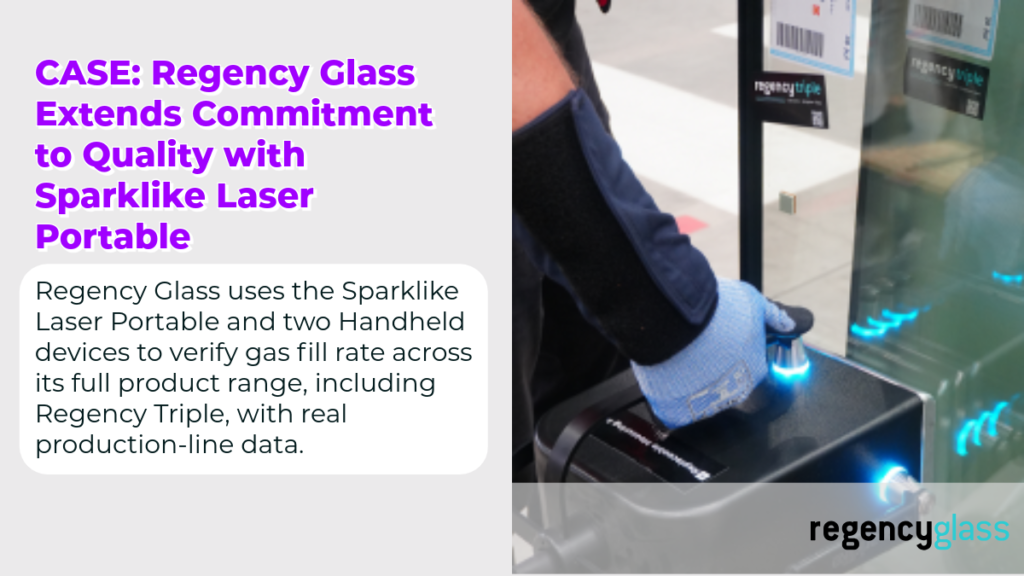
Summary – Advantages of Gas Fill for IGU Thermal Performance and Measurement Developments
Why gas fill matters:
- Filling IGUs with argon, krypton, or xenon improves energy efficiency and reduces heat transfer.
- Argon is the most widely used gas due to its cost-effectiveness compared to krypton or xenon.
- IGUs are generally considered high quality when gas concentration exceeds 90%.
Impact on energy efficiency:
- Double and triple glazing, coatings, and noble gas fills significantly lower the U-factor (energy loss).
- Windows are one of the most critical components in building energy performance.
Challenges for manufacturers:
- Ensuring proper gas fill levels and retention over time is vital for quality.
- Traditional methods (drilling holes and gas chromatography) were destructive, costly, and inefficient.
Breakthrough by Sparklike:
- Developed the world’s first non-invasive gas analysers, now the industry standard.
- Solutions cover different needs:
- Handheld Nova™ – portable testing of double-glazed IGUs.
- Laser Portable™ – for double and triple glazing.
- Laser Integrated™ – automated, in-line quality control in IG production.
Sparklike is the developer of the world’s first non-invasive gas analyser for insulating glass. Our Sparklike Handheld Nova™ and Sparklike Laser Portable™ devices has become the de facto world standard for gas fill measurement of IGUs. Sparklike products are used on a daily basis by the leading insulated glass manufacturers, testing laboratories and window processors world-wide. Alongside the technology, this article discusses the advantages of gas fill for IGU thermal performance and the developments in gas fill measurement.
This is the first article of the Sparklike 20 year anniversary series, detailing the history of Sparklike, development of the products as well as the technology development generally. Read the second article about Sparklike’s story.

Insulating enhancement in modern IGUs
A common insulating enhancement in modern IGUs is filling it with argon, krypton or xenon gas to increase the energy efficiency, slow the transfer of heat as well as improve the general performance of the glass. The insulating gas is applied to the cavity, either during the manufacturing process at a gas press station or manually to the ready-made units. Read What are the differences of Argon, Krypton, and Xenon in Insulating Glass Units?
As product liability for the insulating glass often lasts several years after initial delivery, window suppliers are constantly looking at new ways to increase the security of the gas fill. The challenge usually lies in confirming the correct filling degree and ensuring that the initial gas concentration remains inside the insulating glass unit (IGU).
Read how Sparklike customer EDL Glass verify argon fill rate of insulating glass units.
Glazing & Energy-efficiency
Modern architecture uses glass both as a structural element and as a way to bring more daylight into buildings. At the same time, glass windows are one of the most sensitive building components in terms of energy efficiency. Heat flows in and out of a building through its windows, depending on the building’s location and local weather conditions. With rising energy costs, this has become a key concern for building owners and their suppliers.
The window industry has responded by developing different insulating glass structures. Double and triple glazed insulating glass units (IGUs) combine several elements to improve thermal performance: glass types, frames, sealants and the gas fill in the cavity between the panes. Together, these elements lower the U-value, which measures how much heat passes through the glazing. Double and triple glazing, gas fill and low-emissivity coatings have significantly improved the energy efficiency of windows, making them the standard choice for high-performance IGUs.

Views on gas fill: Why is argon used in windows?
Glass manufacturers aim to maximize resistance to heat conduction and minimize energy loss through the window. Today, the most common way to do this is to fill the space between the glass panes of an IGU with a noble gas.
Vacuum insulated glass, where the space between the panes is a vacuum, also provides excellent thermal performance. However, due to its price and technical limitations, it is still rarely used in today’s window designs. Air fill is another option, but noble gases provide superior resistance to heat conduction compared with air.
| Fill | Thermal conductivity (W/m·K) | Compared with air |
| Air | 0.024 | 100 % |
| Argon | 0.016 | 67 % |
| Krypton | 0.0088 | 37 % |
Krypton insulates better than argon, with about half of its conductivity. Argon is still the preferred choice because it is the most cost-effective noble gas. Krypton is typically 200 to 300 times more expensive than argon, and xenon even more so. Estimates show that the raw material costs of a well-sealed argon-filled IGU are only about 1 % higher than those of an air-filled unit.
Read Why Fill Rate Matters for Reliable Insulation Performance of Insulating Glass.
Gas fill rate: when is it adequate?
Regardless of the gas used, the gas fill rate of an IGU is generally considered adequate when it exceeds 90 %. Requirements vary between markets. The general target is above 90 % with a margin, but some regions have set lower limits that better match the quality level of local IGU manufacturing.
For IGU manufacturers, the challenge is to verify the gas fill rate with reliable measurement, as evidence of consistent product quality. Relevant standards include:
- ASTM E2269-21; Standard Test Method for Determining Argon Concentration in Sealed Insulating Glass Units using Gas Chromatography
- EN 1279-3:2018 Glass in building – Insulating glass units – Part 3: Long term test method and requirements for gas leakage rate and for gas concentration tolerances
- GB/T 11944-2012: Insulating glass unit
Insulating glass performance – the reason for quality control
For IGU producers, high-quality and energy-efficient products depend on two things: proper processing of advanced glass products, such as tempered, laminated and coated glass, and skilful sealing of the gas-filled units.
Some gas escape is normal. The pressure difference between the outside conditions and the gas-filled cavity causes a yearly gas loss of up to 1 %, which is considered acceptable.
Manufacturing quality therefore includes ensuring a correct and adequate gas fill rate in every sealed unit. If processing quality is not high enough, gas escape can be much higher. This leads to quality problems in the glass and, in the worst case, to failure of the entire glass structure.
Read How to Monitor Gas Filling Equipment for Insulating Glass Units
Measuring Gas Fill Rate: The Limits of Destructive Testing
For IGU manufacturers, the challenge has been to ensure that product performance is adequate and the inert gas fill meets the required standards.
Traditionally, gas fill was tested by taking random samples off the production line and drilling holes in the glass. This measured the gas fill rate and, through it, the insulation performance of the unit. The method worked, but it was costly. It destroyed an expensive product, whether the test was done on the production line as part of quality control or on an IGU already installed in a building.
In other words, gas fill could not be measured without damaging the product. There was also no way to measure gas content as part of on-line quality control. As a result, manufacturers could not collect data from every sealed unit they produced, which limited their ability to monitor production and ensure consistent quality.
More reading: Why Break the Insulating Glass Unit for Gas Analysis If You Don’t Have To?

The World’s First Non-Destructive Insulating Gas Analyzers
Industry requirements for IGU quality are increasing and becoming stricter. Verifying the gas fill rate inside insulating glass units requires effective and reliable tools.
Sparklike gas analyzers measure the gas fill rate through the glass, without opening or damaging the unit. Sparklike Handheld Nova™ uses Plasma Emission Spectroscopy (PES) and gives a result in about 2 seconds for standard double glazed units. Sparklike Laser devices use Tunable Diode Laser Absorption Spectroscopy (TDLAS), which also measures triple glazed, coated and laminated units, with a measurement time of 20 to 30 seconds. The accuracy of Sparklike Laser Portable 2.2 has been validated by ift Rosenheim, and later versions are based on the same TDLAS technology.
Because the measurement is non-destructive, manufacturers no longer need to rely on random destructive samples. They can measure on the production line, at final inspection or on-site, and collect data from every sealed unit. Measurement results are stored for traceability, and with Handheld Nova, they can be downloaded as a CSV file from nova.sparklike.com for use in the customer’s own quality software. Read how IGU Manufacturer ToughGlaze checks gas concentration levels with Sparklike Handheld NOVA.
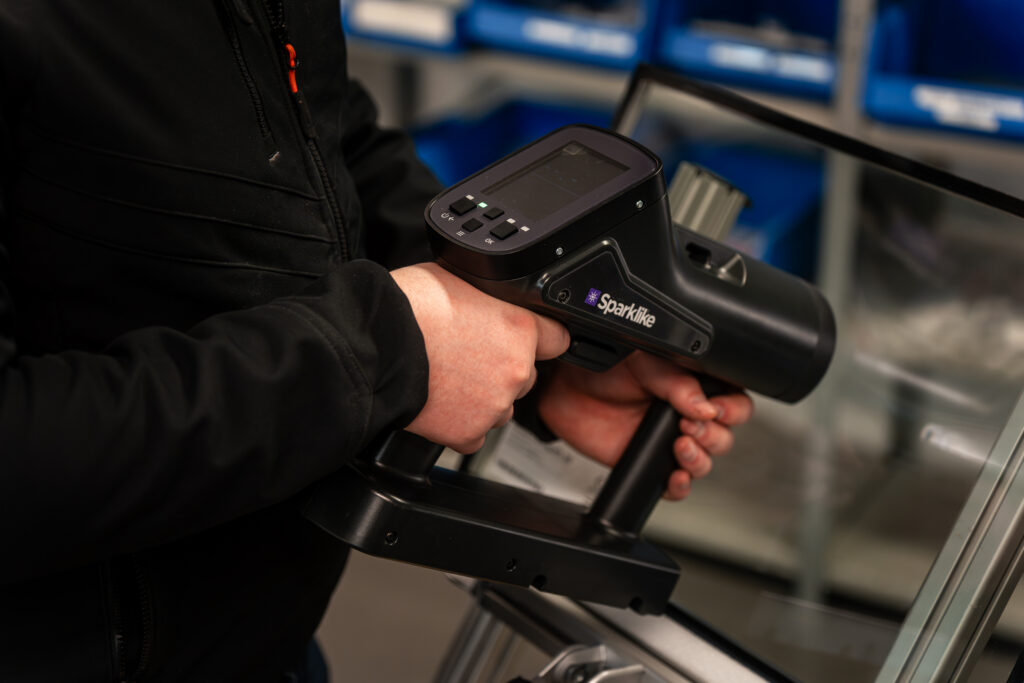
THE SPARKLIKE PRODUCT RANGE CONSISTS OF:
- Sparklike Handheld Nova™ – Portable and battery operated gas fill measurement of standard double glazed IGUs
- Sparklike Laser Portable™ – Measuring IG gas fill of triple and double glazed units
- Sparklike Laser Integrated™ – Automated insulating gas measurement station integrated in the IG production line