Summary – How Sparklike Laser Advances Glass Processing for IGUs
- Sparklike celebrates 20 years of innovation in non-invasive gas measurement for insulating glass units (IGUs).
- Earlier Handheld™ devices solved the challenge of gas measurement but faced limits with triple glazing, coatings, and laminations.
- To meet industry demands, Sparklike developed laser-based technology (TDLAS), launched in 2014.
- Sparklike Laser™ devices (Portable & Integrated) can:
- Measure argon, krypton, and xenon fill levels indirectly via oxygen absorption.
- Work non-invasively through coatings, laminations, and complex triple-glazed IGUs.
- Deliver results in 18–28 seconds with high accuracy.
- Provide both gas content % and glass/spacer thickness (+/- 50 µm).
- The system includes a main unit, measuring head, and user interface, with options to save and export results.
- Product range overview:
- Handheld™ – portable, battery-operated, for standard double glazing.
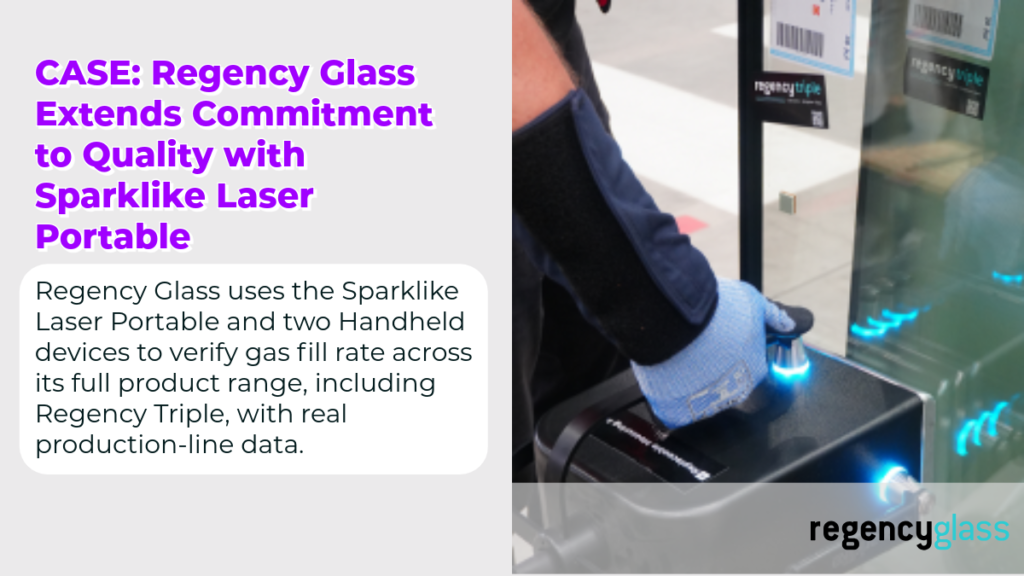
- Laser Portable™ – advanced measurement for double and triple glazing.
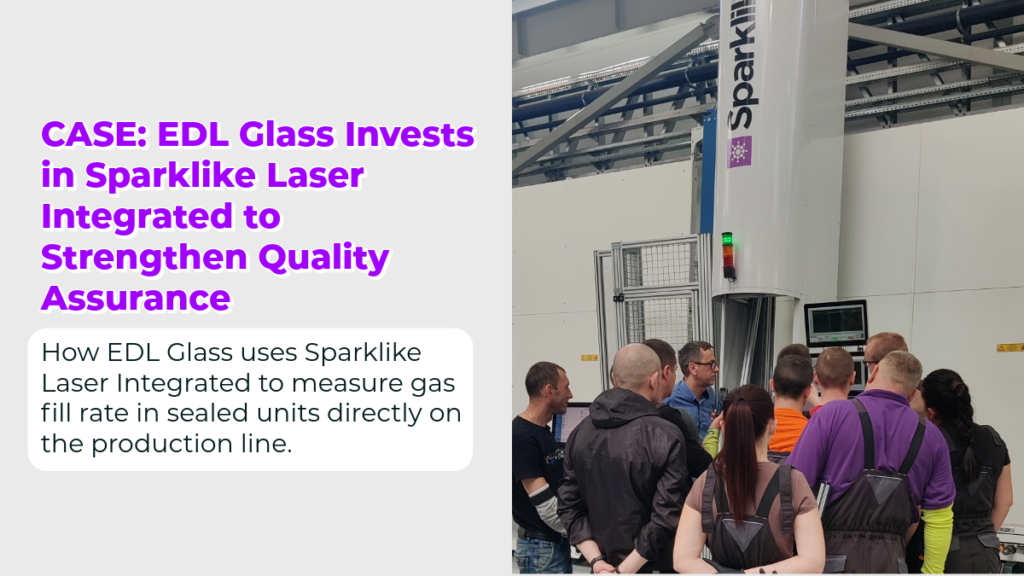
- Laser Integrated™ – automated solution for IG production lines.
In 2020, Sparklike celebrated its 20th anniversary. Over the years, Sparklike Handheld™ and Sparklike Laser™ devices have become widely adopted tools for insulating glass gas fill measurement.
To mark this milestone, Sparklike published a 20-year anniversary article series.
This third article focuses on the technology behind non-destructive insulating gas measurement, building on earlier discussions about advantages of gas fill for thermal performance and the developments in gas fill measurement and applied research and the partnering entrepreneurs behind Sparklike.
Taking Insulating Gas Measurement Further
Earlier Sparklike devices used spectrum analysis technology to measure insulating gas content non-invasively. This approach successfully addressed a major industry challenge at the time.
However, continued developments in insulating glass products introduced new limitations.
- Multiple Low-E coatings became more common
- Laminated structures increased in use
- Triple-glazed IGUs gained market share
These changes created new measurement challenges that existing technologies could no longer fully address.

Why New Measurement Capabilities Were Needed
High-voltage spark technology performed reliably for many years. However, more complex IGU structures required:
- Measurement through multiple coatings
- Measurement through laminated glass
- A single measurement for triple glazing
- Full argon range measurement from 0–100%
- Integration directly into the insulating glass production process
IGU manufacturers increasingly required inline, non-invasive, and repeatable measurement as part of quality control.
Breakthrough Technology: Laser-Based Gas Measurement
In 2011, Sparklike initiated the development of a new measurement approach based on laser technology. This led to the launch of the Sparklike Laser™ product line in 2014.
The technology is based on Tunable Diode Laser Absorption Spectroscopy (TDLAS), operating at a wavelength of 763 nm.
Instead of measuring argon directly, the system measures oxygen absorption inside the IGU. Since oxygen and insulating gas concentrations are complementary, the insulating gas content can be calculated accurately.
Supported gases include:
- Xenon
- Argon
- Krypton
How the Laser Measurement Works
A laser beam is directed into the insulating glass unit from one side only. Reflections from the glass surface are detected and analyzed.
Key characteristics:
- Measurement time: 18–28 seconds
- Non-invasive measurement through coatings and laminations
- Suitable for complex triple-glazed structures
Supported dimensions:
- Maximum IG thickness: 51 mm
- Glass thickness: 2–23 mm
- Spacer cavity: 4–40 mm
This technology enables quality assurance that matches modern high-performance glazing expectations.
Oxygen absorbance
Oxygen has specific absorption lines at known wavelengths. Sparklike Lasers use a tunable, narrow-linewidth diode laser to scan across these absorption lines.
To improve sensitivity:
- The laser wavelength is modulated
- Harmonic signal components are extracted
- Absorbance is calculated from the signal amplitude
The resulting value is displayed as insulating gas concentration (%).
In addition, the system measures:
- Glass thickness
- Spacer cavity dimensions with accuracy of ±50 µm, reported alongside the gas result.
Sparklike Laser System Components
The Sparklike Laser system consists of:
- Main unit (power supply and signal processing)
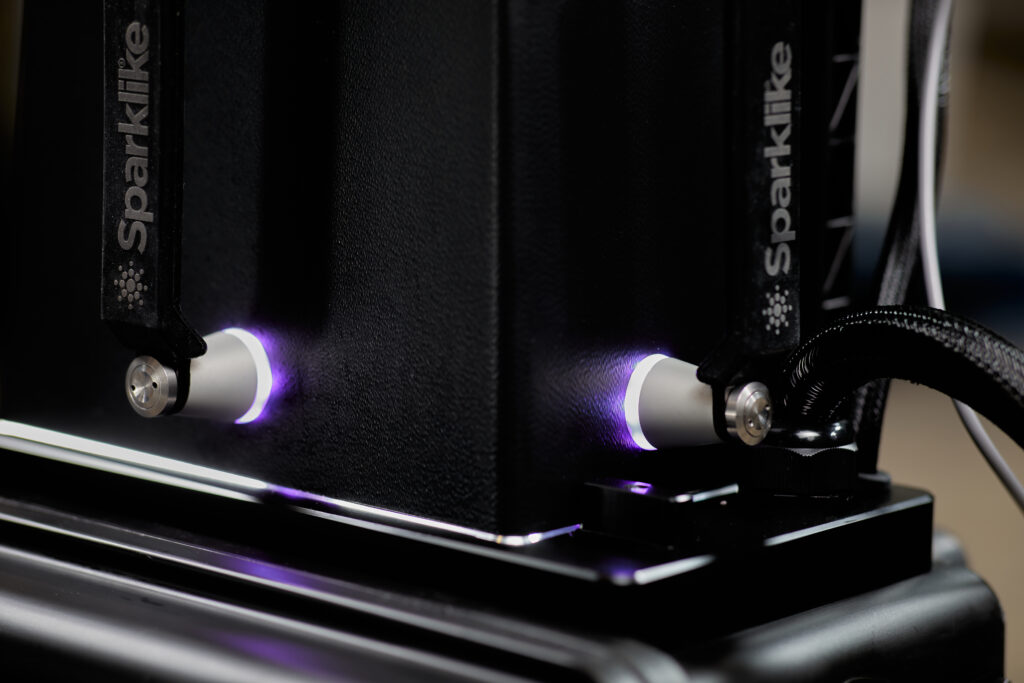
- Measuring head (optics and sensitive electronics)
- User interface screen
The system supports data storage, export, and traceability.
Sparklike Product Range for Insulating Glass Processing
Sparklike Handheld™ – Gas fill measurement of standard double glazed IGUs
Sparklike Laser Portable™ – Measuring insulating glass gas fill of triple and double glazed units
Sparklike Laser Integrated™ – Automated insulating gas measurement station integrated in the IG production line